If you’ve worked with pump motors for any length of time, you’ve probably seen nameplates that read:
208-230/460V
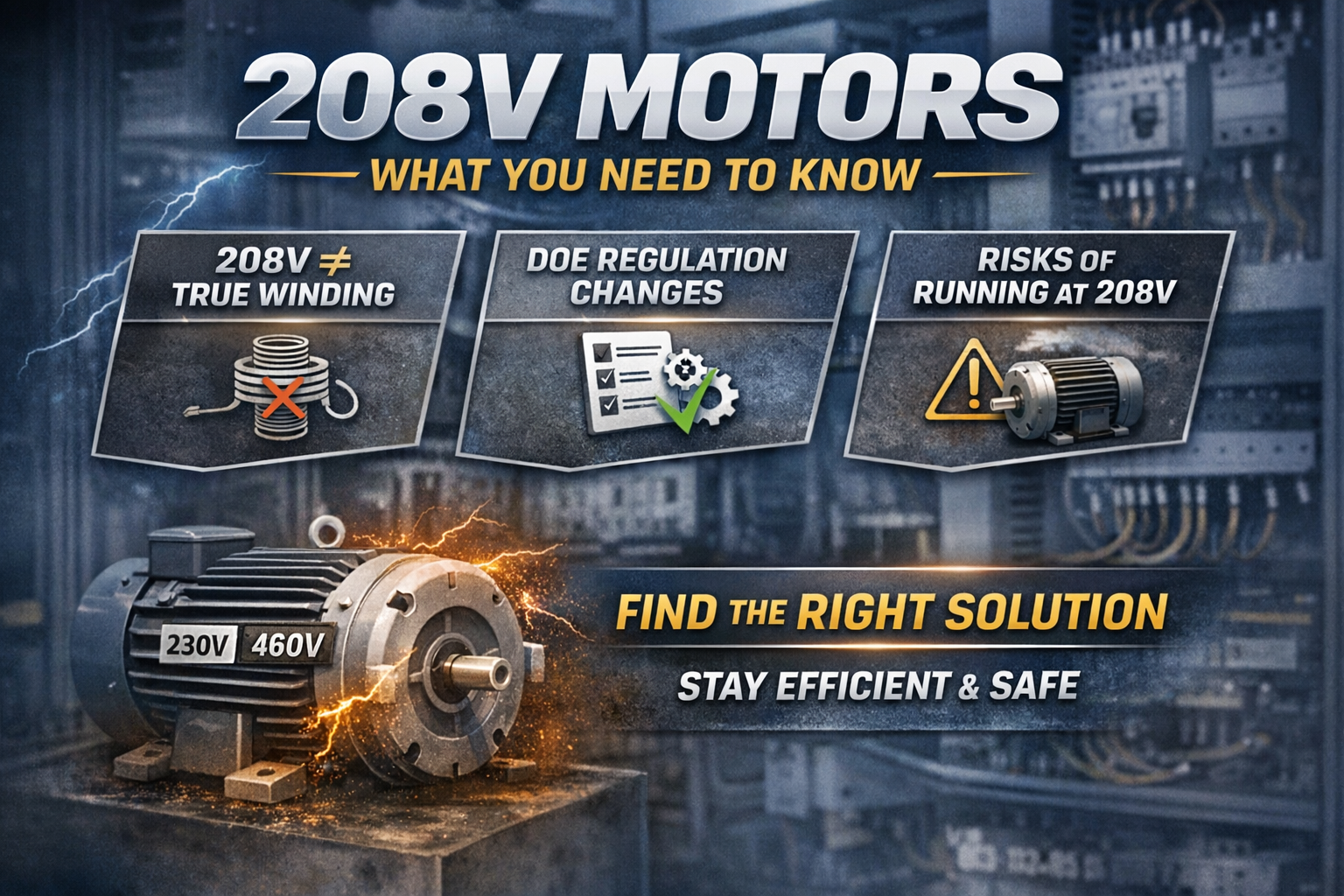
And for years, the assumption was simple. If you had 208V power, you could run that motor without much concern. Since the Department of Energy (DOE) regulation changes that took effect in April 2023, that assumption needs a closer look.
The motors themselves haven’t changed as much as people think, but the way they’re rated, labeled, and evaluated has.
Why 208V Motor Questions Are Coming Up More Often
The DOE now requires that any voltage listed on a motor nameplate must meet minimum efficiency standards at that voltage
That sounds like a small technical detail, but it has a big impact. Before 2023, manufacturers could list multiple voltages on a nameplate, even if the motor wasn’t operating at peak efficiency across that entire range.
Now, if a voltage appears on the nameplate, the motor must meet IE3 NEMA Premium efficiency standards at that exact voltage. That’s the reason you’re no longer seeing “208-230/460V” on newer motors.
What the Old 208-230/460V Motors Actually Were
There’s a common misconception that older motors had a dedicated 208V winding. They didn’t. These motors were built with:
- A 230V winding (low voltage)
- A 460V winding (high voltage)
The 208V rating came from the allowable voltage range. With a ±10% tolerance, a 230V winding could operate down to about 207V. That made it acceptable to label the motor as 208-230V, even though it was not specifically designed for 208V operation. This distinction matters more today than it used to.
https://public.3.basecamp.com/p/hHzxNs7K1v8CkDHaHno6FtJ1
What Changed with the 2023 DOE Regulations
Under the updated rules, manufacturers can no longer list 208V on the nameplate unless the motor meets efficiency requirements at that voltage.
As explained in the DOE white paper, performance characteristics such as efficiency are only valid at the rated nameplate voltage and change as voltage deviates. So if a motor is designed and tested at 230V:
- It will run at 208V
- But it will not meet the same efficiency standard
That’s why modern motors are now typically labeled: 230/460V (not 208-230/460V). Even though physically, they are often the same motors built before 2023.
Can You Still Run a 230V Motor on 208V?
Yes, and this is where a lot of confusion comes in. From a functional standpoint, nothing has changed. A 230V motor can still operate on 208V power because it remains within the ±10% voltage range. However, two important things are now clearer:
- The motor will operate below its rated efficiency
- It may draw higher amperage and run hotter over time
This aligns with what the DOE documentation explains. As the voltage drops below the nameplate rating, the motor compensates by increasing current, which increases heat and reduces efficiency. So while it works, it’s no longer considered optimal.
https://public.3.basecamp.com/p/F77ozGDMMTGtgHfuiE5MHus2
Why 200V Motors Are Getting More Attention
If your application consistently runs on 208V power, a better match is often a 200V-rated motor.
A 200V motor is designed to operate efficiently in that lower voltage range, which leads to:
- Improved efficiency
- Lower operating temperature
- Better long-term reliability
The DOE guidance even notes that when lower voltage is expected, using a 200V motor can optimize efficiency and performance .
The tradeoff is availability. These motors are still less common, especially in pump applications, though that is changing as the market adjusts.
What About IE4 (Super Premium) Motors?
Some manufacturers are addressing this gap with IE4 Super Premium Efficient motors.
These motors are typically designed as:
- 230/460V at IE4 efficiency
- But can effectively rerate to 200/400V at IE3 efficiency
This provides a way to operate more efficiently on 208V systems without requiring a completely different motor platform. It’s not universal yet, but it’s becoming more common.
What the Baldor Example Shows
If you compare older and newer Baldor data sheets for the same motor model, you’ll notice something important.
- The newer motor (post-DOE) is labeled only as 230/460V
- Newer Motor name plate – https://public.3.basecamp.com/p/V4Q2icMpocrjcJJMN9L4U1we
- The older version included a reference to 208V operation on the nameplate or documentation
The key point is that the motor itself did not significantly change. The nameplate and compliance requirements did. That’s why many existing installations continue to operate exactly as they always have.
How to Think About 208V Motor Selection Today
Instead of asking whether a motor “can run” on 208V, it’s more useful to ask:
Is this motor optimized for 208V operation?
If efficiency, temperature, and long-term reliability matter, that distinction becomes important. In stable conditions, a 230V motor on 208V may perform adequately. But in systems with voltage drop or heavy load, the performance gap becomes more noticeable.
Need Help Sorting Through Motor Options?
The 2023 DOE changes didn’t suddenly make 208V applications unusable. What they did was clarify how motors are rated and how efficiency should be evaluated.
A 230V motor can still run on 208V, just like it always has. The difference is that it’s now clearly understood to be operating outside its optimal efficiency point.
If your application runs consistently at 208V, a 200V motor, or an IE4 motor designed for that range, will deliver better performance.
At Southeast Pump & Equipment, we work with engineers, contractors, and facility teams to evaluate real-world operating conditions and match them with the right motor selection.
If you’re trying to decide between 230V, 200V, or newer IE4 options for a 208V system, we can help you make a practical, cost-effective decision.

Travis Glover is the Co-Owner and Sales Manager at Southeast Pump and Equipment, where he assists engineers, contractors, and facility owners in implementing reliable pump, water filtration, and hydronic solutions. With more than 20 years of experience in sales and business development, Travis brings a hands-on approach and a deep understanding of performance-driven systems that support safety, sustainability, and long-term efficiency.