
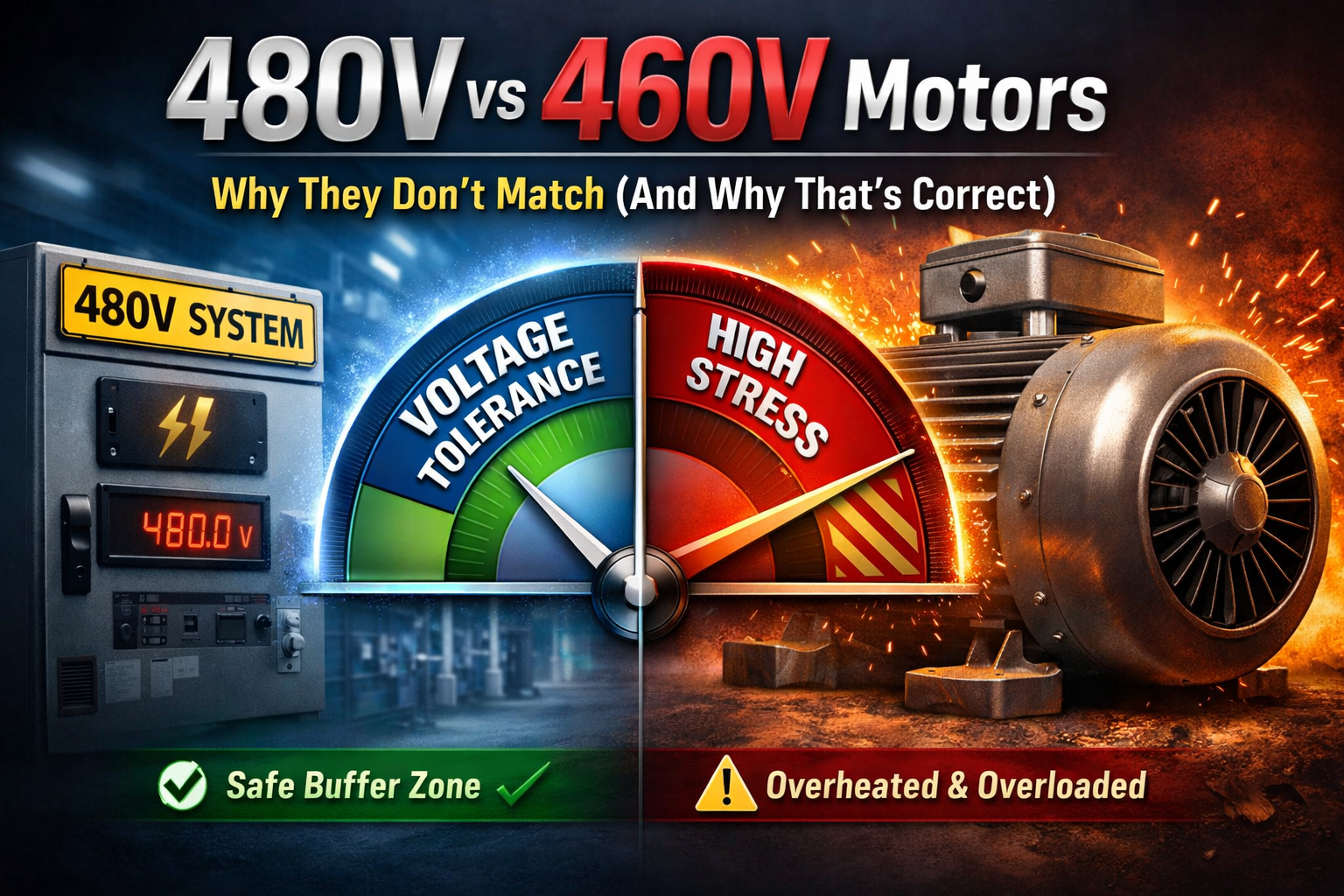
If you’ve ever reviewed a submittal or stood on a jobsite looking at equipment, you’ve probably run into this question:
“If the building is 480V, why is the motor rated 460V?”
It feels like something doesn’t quite line up. In reality, that difference is intentional, and understanding it can help you avoid a lot of confusion and, more importantly, prevent motor performance issues down the road.
Understanding the Difference Between System Voltage and Motor Voltage
The confusion usually comes from mixing two related but different ideas.
The system (or distribution) voltage is what the building or utility provides. In many commercial applications, that’s 480V. The motor nameplate (or utilization) voltage is the voltage at which the motor is designed to operate under normal conditions.
So when you see a 460V motor on a 480V system, you’re not looking at a mismatch. You’re looking at a design that accounts for how power actually behaves in the real world.
Why a 460V Motor Works on a 480V System
Electric motors aren’t designed to operate at a single fixed voltage. Instead, they’re built to handle a range, typically about ±10% of the nameplate rating.
For a 460V motor, that range runs from roughly 414V up to 506V. A 480V system sits comfortably within that window, which gives the motor the flexibility it needs to handle normal fluctuations without being pushed outside its operating limits.
That built-in margin is what allows the motor to perform consistently, even when conditions aren’t perfect.
What Actually Happens as Voltage Changes
Once you move past the nameplate and look at how motors behave in operation, the relationship between voltage and current becomes the key factor.
As voltage increases slightly above the motor’s rating, the motor draws less current. As the voltage drops, it must draw more current to do the same amount of work. Over time, that increase in current translates directly into more heat, which drives insulation breakdown and shortens motor life.
This is where the difference between a 460V motor and a 480V motor becomes more than just a number on a label.
How Real-World Conditions Affect Motor Performance
In a perfect world, a 480V system would always deliver exactly 480V. In reality, voltage fluctuates throughout the day depending on demand.
During periods of heavy load—like a hot summer afternoon when air conditioning systems are running at full capacity—it’s common for system voltage to sag below 480V.
When that happens, a 460V motor actually moves closer to its ideal operating point, at least initially. It continues to run efficiently and, in many cases, still draws less than its nameplate current.
As the voltage continues to drop, the motor eventually draws more amperage, and that’s when heat starts to build. But because the motor started with some buffer, it takes longer to reach that point.
Why a 480V Motor Can Be a Disadvantage
If the motor is rated at 480V instead, that buffer disappears.
As soon as the system voltage drops—even slightly—the motor is already operating below its intended voltage. From that point on, every additional volt of drop pushes it further away from optimal performance.
The motor compensates by drawing more current sooner, which leads to higher operating temperatures and increased stress on internal components. Over time, that translates into reduced reliability and a shorter service life.
This is why 480V nameplate motors are less common, often more expensive, and generally not preferred in typical commercial applications.
The Same Concept at 240V Systems
This isn’t unique to 480V systems. The same principle applies at lower voltages as well.
A 240V system typically uses a 230V motor for the exact same reason. The motor is designed with a margin that allows it to handle normal voltage variation without constantly operating under stress.
Why This Matters During Submittals and Installation
When you see a 460V motor specified for a 480V system, it doesn’t need to be corrected. It’s usually the right choice.
Problems tend to arise when it is assumed that the motor voltage should exactly match the system voltage. That approach ignores how voltage actually fluctuates in the field and can lead to higher amp draw, overheating, and premature failure.
By understanding the relationship between distribution voltage and utilization voltage, you can make better decisions during submittals, avoid unnecessary changes, and ensure the equipment performs as expected once it’s installed.
Need Help Reviewing Motor Selections?
A 480V system paired with a 460V motor isn’t a mismatch. It’s a design strategy that gives the motor room to handle real-world conditions.
That extra margin allows the motor to operate more efficiently under normal conditions and better tolerate the voltage drops that occur during peak demand. Over time, that translates into lower operating stress and longer equipment life.
At Southeast Pump & Equipment, we work with engineers, contractors, and facility teams to evaluate motor selections based on how systems actually perform, not just what’s listed on paper.
If you’re reviewing a submittal, troubleshooting a voltage issue, or just want a second opinion, we’re happy to help you make a more informed decision. Please reach out to us to speak with an expert or check out our motors page.

Travis Glover is the Co-Owner and Sales Manager at Southeast Pump and Equipment, where he assists engineers, contractors, and facility owners in implementing reliable pump, water filtration, and hydronic solutions. With more than 20 years of experience in sales and business development, Travis brings a hands-on approach and a deep understanding of performance-driven systems that support safety, sustainability, and long-term efficiency.