
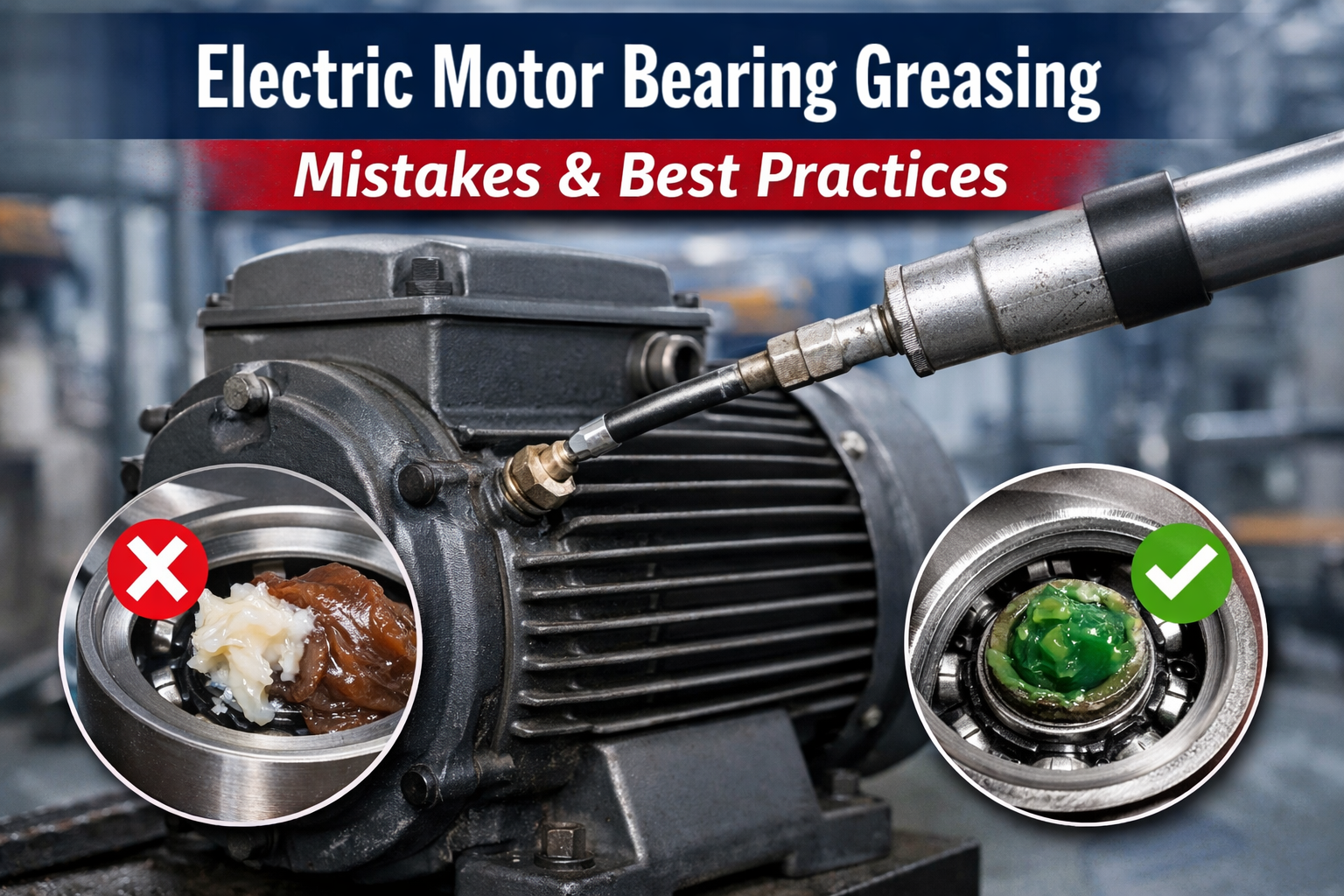
Greasing motor bearings seems simple on the surface. Add grease, keep things lubricated, and move on. In reality, it’s one of the most misunderstood maintenance tasks, and one of the most common causes of premature motor failure.
If you’re maintaining pump motors or rotating equipment, understanding how grease actually works and how it fails can make a significant difference in equipment life and reliability.
Why Grease Problems Are So Common
Most bearing failures tied to lubrication don’t come from a lack of grease. They come from using the wrong grease, applying it incorrectly, or mixing incompatible types. One of the biggest misconceptions is what grease actually is. Grease is not just a lubricant. It’s a combination of:
- Oil (about 90%), which does the actual lubricating
- Thickener (about 10%), which holds the oil in place
The oil is what protects the bearing. The thickener’s job is simply to keep that oil where it needs to be. We know from experience that problems start when that balance is disrupted.
The Hidden Risk of Mixing Greases
In many facilities, different grease types get used interchangeably without much thought. That’s where things can go wrong. As outlined in the original study (see compatibility chart in the attached PDF), not all greases are compatible. Some combinations break down the grease’s structure entirely.
A common example is mixing:
- Polyurea grease (commonly used in new motor bearings)
- Lithium-based grease (commonly used in maintenance departments)
When these are mixed, the thickener structure can collapse. Instead of staying in place, the grease separates into oil and runs out of the bearing. What’s left behind is a bearing with little to no effective lubrication. This is why you sometimes see motors that appear to be “full of oil,” yet the bearings have failed. The lubrication didn’t stay where it was needed.
Why Standardizing Grease Matters
Because of compatibility issues, many motor manufacturers now specify polyurea-based grease for electric motor bearings.
As noted in the document, using the same grease type for both new and rebuilt motors helps eliminate the risk of incompatibility.
The key takeaway is simple:
If you don’t know what grease is already in the bearing, adding a different type can do more harm than good.
The Bigger Issue: Over-Greasing
Surprisingly, more motors fail from over-greasing than under-greasing.
It’s a common habit to add grease regularly as a precaution. In practice, this often leads to excessive buildup inside the bearing housing.
When too much grease is added:
- Internal pressure increases
- Heat rises
- Seals can be damaged
- Lubrication becomes less effective
As the original guidance states, simply adding “a couple of shots a week” is not a good maintenance strategy—especially if the grease relief plug is never removed.
The Right Way to Grease Motor Bearings
Proper greasing is less about frequency and more about process. The most effective method is to grease the motor while it is running, allowing old grease to be pushed out as new grease is added.
A typical process looks like this:
- Remove the grease relief plug
- Clean the grease fitting
- Add grease slowly until clean grease exits the relief port
- Allow the motor to run until the excess grease stops flowing
- Reinstall the plug
This ensures that old grease is purged and replaced with fresh, effective lubrication.
How Often Should You Grease Bearings?
This is where things become less straightforward. There is no universal schedule that works for every motor. Some manufacturers recommend long intervals, while others vary based on load, environment, and duty cycle. What works best in practice is developing a schedule based on actual conditions.
A useful rule of thumb is to observe what comes out during regreasing:
- If the grease coming out looks clean and similar to what’s going in, you may be greasing too often
- If hardened or contaminated grease has to be forced out, the interval is likely too long
Over time, this approach helps you dial in the right frequency for each application.
A More Practical Approach to Maintenance
In many facilities, we have seen first-hand that maintenance becomes reactive. Motors are repaired or replaced after failure rather than properly maintained. A more deliberate approach to lubrication can change that.
By using the correct grease, avoiding incompatibility, and following a consistent process, you can reduce downtime, extend motor life, and avoid unnecessary repair costs.
Need Help with Motor Reliability or Maintenance Practices?
Greasing motor bearings is not just a routine task. It’s a critical part of equipment reliability. Using the wrong grease, mixing incompatible types, or over-greasing can all lead to premature failure, even when everything appears to be maintained properly.
When grease is applied correctly and consistently, it does what it’s supposed to do: protect the bearing, control heat, and extend the life of the motor.
At Southeast Pump & Equipment, we work with facility teams, contractors, and engineers to troubleshoot motor issues and improve long-term reliability.
If you’re seeing repeated bearing failures or want to standardize your maintenance approach, we can help you identify what’s really going on and how to fix it. Please reach out to us to speak with an expert or check out our motors page.

Travis Glover is the Co-Owner and Sales Manager at Southeast Pump and Equipment, where he assists engineers, contractors, and facility owners in implementing reliable pump, water filtration, and hydronic solutions. With more than 20 years of experience in sales and business development, Travis brings a hands-on approach and a deep understanding of performance-driven systems that support safety, sustainability, and long-term efficiency.